The short answer
- Mark the length first, in the shoes you will actually wear, and fold both legs the same way.
- A regular fold hem is the simplest: cut, fold twice, press, topstitch.
- Keeping the original hem preserves the worn-in edge. It means stitching above the factory hem and folding the extra fabric up.
- No-sew hem tape works for light fabric and temporary fixes; on thick denim it often lets go.
- Go to a tailor for chain-stitch hems, heavy raw denim, flares with a wide opening, or if you only own one pair you can't risk.
Most store jeans are sold long, because it is easier to take length away than add it. Hemming at home takes a sewing machine that can handle thick fabric, a jeans needle and an hour. First get the length right, because that is the part you can't undo.
Step zero: mark the length for your shoes
- Put the jeans on with the shoes you will wear them with most. Heels, boots and sneakers need different lengths.
- Stand straight, in front of a mirror, with the jeans at your normal waist.
- Fold the hem up from the outside, one leg at a time, until the length looks right, then pin it.
- Take them off and measure the inseam of each pinned leg so you can match the legs exactly.
| Shoe | Common target length | Watch for |
|---|---|---|
| Flat sneakers, loafers | Hem grazes the top of the shoe, with a slight break | Straight or slim legs that stack at the ankle if left too long |
| Boots | Long enough to fall over the boot shaft or sit just above it, depending on the leg | Slim jeans that ride up when you sit |
| Heels | Close to the floor at the back, measured while wearing the heels | Hemming flat-shoe length when you wear heels |
These are common tailoring conventions, not rules. Preference varies; our post on how long jeans should be goes through the options, and how to measure your inseam shows how to record the number.
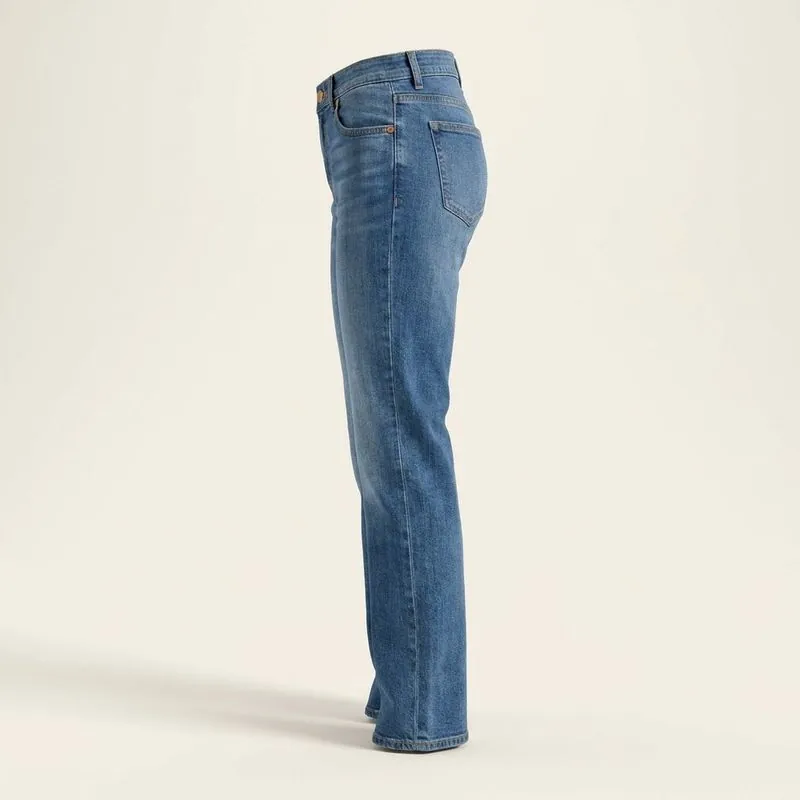
Method 1: regular fold hem
- Pin to the length you want, then mark the fold line with chalk.
- Add an allowance below the fold line: about 1.5 inches for a double fold (1/2 inch first fold, 1 inch second). Cut the rest off, keeping both legs identical.
- Fold the raw edge up 1/2 inch and press hard. Fold again by 1 inch and press.
- Use a jeans needle (size 100/16 or 110/18) and topstitch thread. Stitch close to the upper fold.
- Where the inseam and outseam create bulky layers, tap them flat with a hammer before sewing. The needle will break otherwise.
Method 2: keep the original hem
This keeps the faded, slightly puckered factory edge, which is what makes a hemmed pair look like the original.
- Measure how much shorter you want the leg. Mark a line that distance above the original hem, all the way around.
- Fold the extra fabric up to the inside along the marked line so the original hem sits at the new length.
- Stitch around the bottom of the folded section, close to the original hem seam, and press.
- Trim the spare fabric inside, leaving a small allowance above the stitching.
The result is a bulky seam on the inside and, on thick denim, some stitching that doesn't match the original line. Working out the stitching is the hard part; a tailor with a specialist machine does it more cleanly. Our chain-stitch hem explainer shows what a factory edge involves.
Method 3: no-sew hem tape
Iron-on hem tape is a double-sided heat-activated adhesive. Follow the pack directions for heat and time. It suits light fabric and a quick fix. Heavy denim is the weak spot: the bond often fails after a few washes, and the tape can leave a stiff ridge. Treat it as temporary.
Cuffing is not hemming, but it's free
If you are not sure about the length, cuff the jeans for a week or two. It costs nothing and you can see how the length looks in daily wear before you cut.
When a tailor is better
- You want a chain-stitch or raw hem, which needs specific machines.
- The jeans are heavy raw or selvedge denim.
- The leg is a wide flare or wide leg, where the hem's curve has to be matched.
- You are shortening a lot: removing several inches may change how the leg hangs, and a tailor may recommend taking it from the knee instead.
- It is the only pair you love. Our guide to altering jeans or going custom helps you decide.
The longer fix: jeans cut to your length
Hemming fixes length. It doesn't fix a thigh or seat that is wrong. Our jeans are made to your measurements, so length is set at the start. You can copy the inseam of a pair that already fits you, laid flat, or measure your body. Hem finishes include regular, raw/frayed, cuffed and chain-stitch (+$10). Taller or shorter than average? See jeans for shorter men and tall women's jeans.
Questions
How much does it cost to hem jeans at a tailor?
Prices differ widely by region and by method, and keeping the original hem costs more than a standard hem. Get a quote from a local shop before you drop them off.
Can you hem jeans without a sewing machine?
You can hand stitch or use iron-on tape, but both are weak on thick denim. A machine with a jeans needle gives a hem that survives washing.
How long should jeans be when hemmed?
That depends on the shoes and the leg shape. Mark the length in the shoes you wear most, and see our length guide for the common options.
Should I hem jeans before or after washing?
Wash and dry them first the way you normally will. Denim can shrink, mostly in length, and you don't want to hem to a length that later changes.
Can I keep the original hem on raw denim?
It is possible but harder, because the original stitching and fade are part of the look. A tailor with the right machine will give a cleaner result.