The short answer
- A chain stitch is a looped stitch made from one continuous thread, like links of a chain.
- It's the traditional jeans hem, and with wear it can twist the hem edge into a rippled 'roping' fade.
- Roping depends on the fabric, the wear and the washing; no hem can promise it.
- At Jeanszilla a chain-stitch hem is +$10; regular, raw/frayed and cuffed hems are the other options.
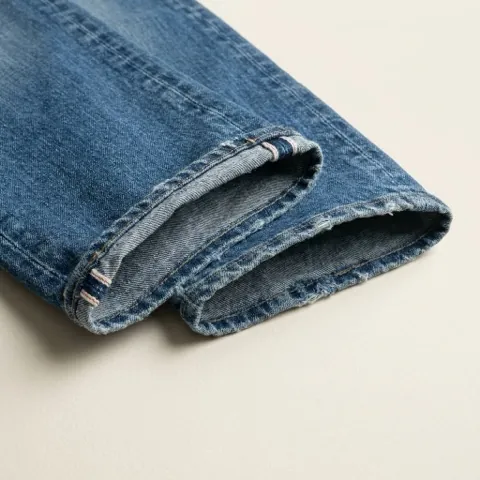
Look closely at the hem of a pair of vintage jeans and you'll often see it: a band of twisted, rippled fading along the bottom edge, paler on the ridges and dark in the valleys. Denim fans call it roping, and the usual source is a chain-stitched hem. Here's what that means and whether it's worth choosing.
What a chain stitch is
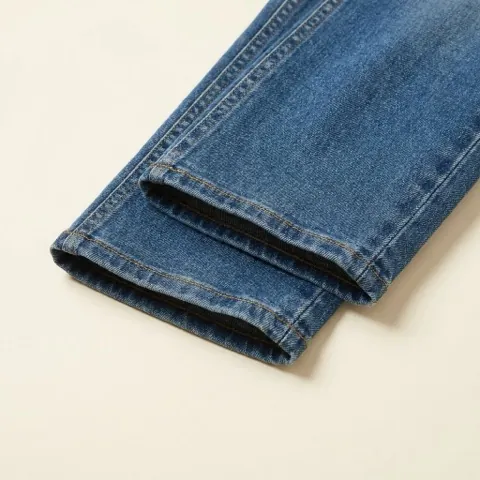
A chain stitch is a looped stitch that resembles the links of a chain, formed from a continuous thread looping back on itself (Heddels glossary). On the outside of the hem it looks like a neat row of straight stitches; on the inside you see the chain of loops. A regular hem uses a lockstitch, where two threads interlock through the fabric, which is flatter and holds firm even if a stitch is cut.
Because it's made from looped thread, a chain stitch has a little give, and as it's sewn it pulls the folded hem slightly. Over time, as the denim shrinks, softens and fades, that pull can twist the hem edge into ripples, and the raised ridges fade faster than the valleys. That's roping.
Why roping isn't guaranteed
Denim enthusiasts disagree about what causes the effect: the stitch, the machine's folder, the way the fabric feeds through, or the denim shrinking after it's sewn. What's clear is that the conditions matter: rigid, unwashed or raw denim that shrinks a little and is worn hard shows it most; soft, pre-washed stretch denim often barely ropes at all. So treat roping as a possible bonus, not a feature. We don't promise it, and nobody honestly can.
Hem options compared
| Hem | Look | Best with | Watch out for |
|---|---|---|---|
| Regular | Flat, clean, invisible from a distance | Any fit, any wash; office jeans | Nothing; it's the safe default |
| Chain-stitch (+$10) | Heritage; may rope with wear | Raw and rigid denim, straight and relaxed legs, cuffed or full length | The looped thread can unravel if a loop is snagged and pulled; have a loose end re-stitched promptly |
| Raw / frayed | Casual, soft edge that frays further with washing | Cropped and ankle lengths, mom and barrel shapes | Frays a little more each wash; that's the point |
| Cuffed | Turned-up hem showing the inside of the denim | Straight, slim and selvedge legs | Length must allow for the cuff; see the cuffing guide |
Choosing a chain-stitch hem
It's a good choice if:
- You're ordering rigid or raw denim, such as Classic Rigid 13 oz or Japanese-style Selvedge 14 oz raw.
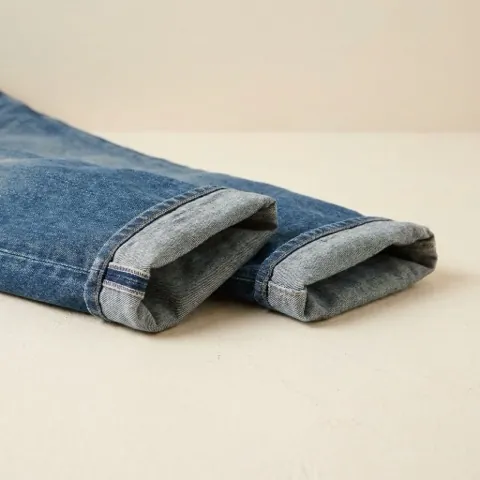
- You'll cuff your jeans, so the inside of the hem shows. How to cuff jeans has the options.
- You like heritage details: a button fly, classic gold thread and a straight leg go well together.
When not to choose it
- You want a perfectly flat, discreet hem for work, especially on a slim or skinny leg in stretch denim.
- You're likely to have the jeans shortened later. Not every alterations shop has a chain-stitch machine, so a later hem may be a regular one.
- You'd choose it only for the roping, on a soft stretch fabric. That combination rarely delivers.
Getting the length right first
A beautiful hem in the wrong place is still the wrong hem. Measure the inseam of a pair whose length you like, or measure yourself in the shoes you'll wear; how long should jeans be walks through it, and if you plan to cuff, add the cuff to your notes for the tailor. Choose the hem on any style, for example men's straight jeans or women's straight jeans. For the fabric that ropes best, see what is selvedge denim.
Questions
What is a chain-stitch hem on jeans?
A hem sewn with a looped chain stitch instead of a flat lockstitch. It's the traditional way to finish a jeans leg and can produce a rippled fade called roping.
What is roping on jeans?
A twisted, rippled effect along the hem, where the raised ridges fade faster than the folds. It develops with wear and washing, mainly on rigid and raw denim.
Is a chain-stitch hem stronger?
Not necessarily. It wears well, but because it's a looped stitch, a snagged loop can unravel if it's pulled. A quick re-stitch fixes it.
Can stretch jeans have a chain-stitch hem?
Yes, but soft, pre-washed stretch denim rarely ropes much. Choose it there for the look of the stitching rather than for fades.
Can a tailor shorten jeans with a chain-stitch hem?
Any tailor can shorten them, but only shops with a chain-stitch machine can re-create the original stitch. Get the inseam right at order time.