The short answer
- Measure where your waistband lands, not automatically at your natural waist. The two can be several inches apart.
- The easiest accurate method: lay a pair that fits flat, smooth the waistband, measure straight across, and double it.
- Your tape number and the tag number often differ, because tags are labels and brands cut to their own patterns.
- Make the measurement match the way you will compare it. Body to body, jeans to jeans.
"Measure your waist" sounds like a one-step job, until you ask which waist. The narrowest part of your torso, the top of your hip bones and the spot where your last pair of jeans sat can be three different places, with three different numbers. Measure the wrong one and the jeans arrive too tight or too loose. Here's how to measure the right one.
Natural waist vs where the waistband sits
Your natural waist is the narrowest part of your torso, usually above the navel. Jeans rarely sit there. A low rise lands on your hips, a mid rise just under the navel, and a high rise around the natural waist or above it (see what rise means). The body keeps widening as you go down, so a waistband that sits lower is wider than your natural waist. One tailoring guide lists measuring the natural waist instead of the place the jeans sit as a common mistake and suggests placing the tape where the waistband actually lands (Blue Beach Denim).
| Where you wear your jeans | Put the tape |
|---|---|
| Low, on the hips | Across the hip bones, where the waistband will sit |
| Mid, just below the navel | An inch or two below the navel |
| High, at the natural waist | At your narrowest point, above the navel |
A simple rule: put on a pair you like, feel where the top edge lands, and measure there.
Method 1: measure your body
- Use a soft tape, over thin clothes or on bare skin. Stand relaxed and breathe out normally; don't pull in your stomach.
- Wrap the tape around your body at the spot from the table above, keeping it level with the floor all the way round.
- Snug but not tight: you should be able to slide a finger under it.
- Read the number where the tape meets the end. Do it twice.
Then measure your hips at the fullest point. A waist alone does not tell you how the seat will fit.
Method 2: measure a pair of jeans (usually more reliable)
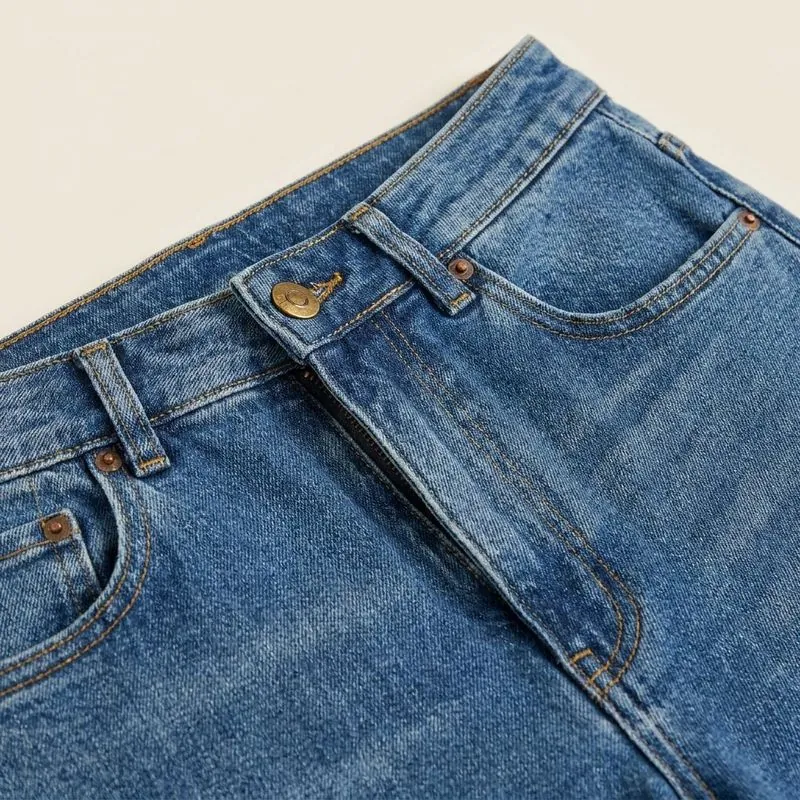
- Button the jeans and lay them flat. Smooth the waistband and line up the front with the back.
- Measure straight across the top of the waistband, from edge to edge.
- Double the number. A 17-inch measurement across is a 34-inch waist.
Check how the source you're comparing against measured. Guides describe a "relaxed" method (point to point on the flat jeans) and a "top edge" method (pull the top edges together), and the top-edge result is generally a little larger (DenimBMC). Use the same method every time. Since a waistband is slightly curved, some guides add a small allowance, about 2 cm, when converting a flat reading to a circumference. Because of that, keep your own method consistent and compare like with like.
Why the tape and the tag disagree
- Tags are labels. One retailer says its women's 28 is a 29-inch waist (Madewell denim guide). Sizing has no enforced standard, so a pair can measure above or below its tag. See why jeans sizes differ between brands.
- Different spots. Your natural waist and your waistband are not the same circumference.
- Stretch. A stretch denim gives a little at the waist, a rigid one doesn't, so the comfortable number differs.
- Posture. Sitting, a big meal and time of day can change a reading. Measure standing, relaxed.
How to use your number
Compare body to body, or jeans to jeans, never one against the other. If your best-fitting pair measures 34 flat-doubled and your body measures 32 at the spot it sits, the jeans have about 2 inches of ease built in. That ease is what you want to repeat, and our ease explainer shows why.
When you order women's or men's custom jeans we ask for your waist, at whichever rise you pick, and your hips; waist runs from 24" to 70". You can copy your best-fitting jeans, measured flat, or measure your body; height and weight are optional. Our team compares the numbers and emails you within 1 working day if something looks unusual. The measuring guides cover both methods, and the Fit Guarantee backs the first pair in each fit.
Questions
Where should I measure my waist for jeans?
Where the waistband will sit. For low rise that is across the hips, for mid rise just below the navel, and for high rise at your natural waist.
Is my jeans waist the same as my natural waist?
Often not. Natural waist is the narrowest part of your torso, while most jeans sit lower, where your body is wider.
How do I measure the waist of a pair of jeans?
Button them, lay them flat, line up front and back, measure straight across the top of the waistband and double it.
Why are my jeans bigger or smaller than the tag says?
Tags are labels, not guarantees, and brands cut to their own patterns. Stretch and rise also change how a number feels.
Should I measure with a tape or with jeans?
Either, but compare like with like. Jeans measured flat usually match a brand's garment measurements best.