The short answer
- Selvedge (or selvage) is a self-finished fabric edge that won't fray, woven on a traditional shuttle loom.
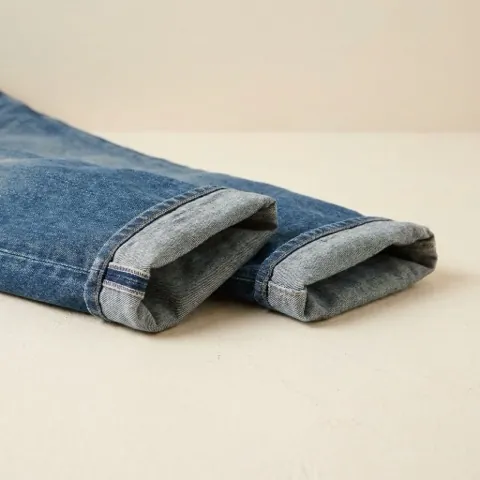
- Shuttle-loom cloth is narrow, so jeans use the edge as the outseam. That's why it shows when you cuff.
- Look for a clean band, often with a colored line, inside the outseam, with no overlocking.
- Selvedge tells you how the cloth was woven. It doesn't, by itself, tell you the jeans are better.
Turn up the hem of some jeans and you'll see a neat white band with a colored line running up the inside of the outer seam. That's selvedge, short for "self-edge". It's the most recognizable detail in denim, and also one of the most misunderstood. Here's what it is, how to check for it, and whether it's worth paying for.
How a shuttle loom makes the edge
On a shuttle loom, the crosswise (weft) yarn is carried back and forth across the warp in one continuous length. Each time it reaches the side, it turns and goes back, so the edge of the cloth is bound by the yarn itself. Nothing needs cutting or finishing. Most denim today is woven on faster shuttleless looms, which insert the weft in cut lengths and leave a loose fringe that has to be finished.
Shuttle looms are slower and weave narrow cloth, usually around 30 inches wide according to the Denimhunters denim wiki, while shuttleless looms weave much wider fabric. Narrow cloth means a pattern maker lays the leg pieces so the outseam runs along the finished edge, which is why the edge ends up inside the outer seam.
Selvedge vs regular denim at a glance
| Selvedge | Non-selvedge | |
|---|---|---|
| Loom | Shuttle | Shuttleless (projectile, rapier and similar) |
| Fabric edge | Self-finished, won't fray | Cut fringe, needs finishing |
| Width | Narrow (around 30") | Much wider |
| Outseam inside | Clean band, often with a colored line | Overlocked (serged) edges |
| When cuffed | Shows the edge | Shows overlocking |
| Cost | Higher: slower weaving, more fabric used per pair | Lower |
How to spot real selvedge: a 30-second check
- Turn up the hem and look at the inside of the outseam (the seam on the outer side of the leg).
- Selvedge shows two clean, flat edges pressed open, often with a colored line along them.
- Regular denim shows overlocking: a tight zigzag of thread wrapped around the raw edges.
- Follow the edge up the leg with the jeans inside out. Real selvedge runs the full length of the outseam.
- Be wary of a short strip of "selvedge-look" tape only at the hem; it's decorative, not woven.
The colored line is an ID thread the mill weaves in. Red is the classic, but any color is possible, and the color says nothing about quality.
What selvedge does and doesn't tell you
Selvedge tells you the cloth came off a shuttle loom. It doesn't tell you whether the denim is raw, how heavy it is, how it will fade, or whether the jeans fit. As the Denimhunters wiki says, the edge alone can't tell you whether a pair is good. Plenty of excellent denim is woven on modern looms, and selvedge jeans can be cut badly. Treat it as a detail you enjoy, not a quality certificate.
It's also often paired with raw denim, but the two are separate ideas. See raw denim shrinkage and break-in for what raw means for washing.
When selvedge isn't worth it
- You never cuff. If the hem stays down, nobody sees the edge but you.
- You want lots of stretch. Selvedge is traditionally rigid cotton; for a close, flexible fit, a stretch fabric is the better tool.
- You live somewhere hot. Many selvedge cloths are midweight or heavier. Check the denim weight guide.
- Budget matters more than detail. The extra cost buys a weaving method, not a better fit.
Our option: Japanese-style Selvedge, 14 oz raw
Jeanszilla offers Japanese-style Selvedge, a 14 oz raw denim (+$40). "Japanese-style" describes the kind of cloth: narrow selvedge, raw and midweight, in the tradition Japanese mills made famous. It isn't a claim about where the cloth was woven. It suits cuts with a straight, clean outseam that show a cuff well, like men's straight and men's slim. If you plan to show the edge, ask for the cuffed hem and read our guide to cuffing jeans.
Questions
Is it spelled selvedge or selvage?
Both are correct. Selvedge is more common in British English and in denim circles; selvage is common in American English.
Why does selvedge denim cost more?
Shuttle looms weave more slowly and produce narrower cloth, so each pair takes more weaving time and uses more fabric length.
Is all raw denim selvedge?
No. Raw means unwashed; selvedge means the edge was woven on a shuttle loom. You'll find raw non-selvedge and washed selvedge jeans.
Does the color of the selvedge line mean anything?
It's an identification thread chosen by the mill. Red is traditional, but the color isn't a mark of quality.
Can selvedge jeans be tapered or hemmed?
Yes, but tapering usually happens on the inseam so the selvedge outseam stays intact. Hemming is straightforward.