The short answer
- Catch it early: a thin spot is far easier to mend than a hole.
- Darning (rebuilding the weave with stitches) suits small holes and thin areas, including the inner thigh.
- Patching from the inside suits bigger holes; a visible patch suits knees and work jeans.
- When the fabric around the hole is thin too, or there are holes in several places, it's usually time to retire the pair.
Jeans rarely fail all at once. A pale patch on the inner thigh turns thin, then into a slit, then into a hole that grows every wash. The earlier you step in, the less visible and the stronger the repair. Here's how to choose a method and do it.
Which repair for which hole
| Damage | Best repair | Needs | Visibility |
|---|---|---|---|
| Thin spot, no hole yet (often inner thigh) | Darn now, with a patch behind it | Sewing machine or needle, matching thread, scrap denim | Low |
| Small hole, up to about 1" | Darning over an inside patch | As above | Low to medium |
| Larger hole at the thigh or crotch | Inside patch covering the whole worn area, then darned | Sewing machine helps a lot | Medium |
| Knee hole or ripped knee | Inside patch (keeps the frayed look) or outside patch | Needle and thread is enough | Your choice |
| Split along a seam | Re-sew the seam | Strong thread, small stitches | Low |
Darning: rebuilding the weave
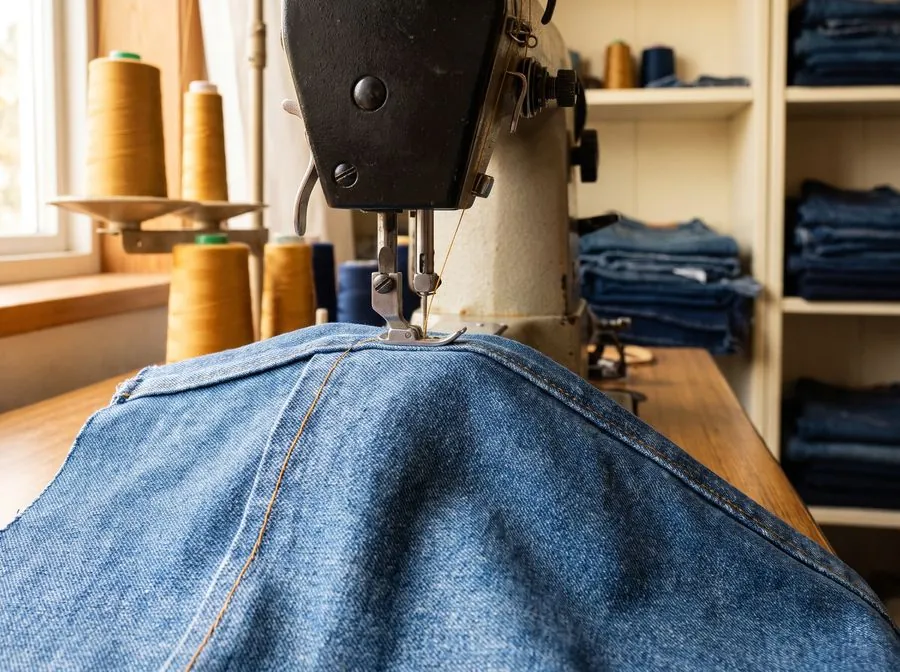
Darning means sewing rows of stitches back and forth across the damaged area, then across those rows, so the thread forms a new woven surface. It's best for small holes that don't run along a seam, and a sewing machine is the fastest way to do it, though it can be done by hand (MasterClass mending guide).
- Turn the jeans inside out. Trim loose threads, but don't cut away the thin fabric around the hole; it gives the darn something to hold.
- Cut a patch of scrap denim or iron-on mending fabric that extends at least 1" beyond the worn area on every side. On the inner thigh, go bigger: if one side has worn through, the other side is usually thin too.
- Pin or iron the patch inside, behind the hole.
- Turn the jeans right side out. With thread close to the denim color, stitch straight lines back and forth across the area, close together, going about 1/2" past the hole on each side.
- Turn the work and stitch across your first lines. Stop when the area feels solid and flexible.
Patching knees
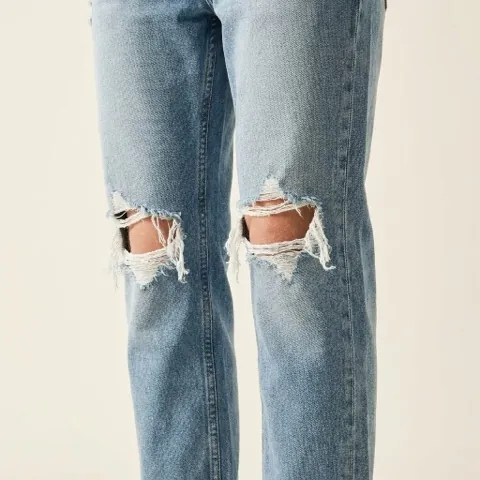
For a hole at the knee, you have two looks. An inside patch is sewn behind the hole and stitched around its edge, leaving the frayed threads on top, a tidy version of a ripped knee. An outside patch is a piece of denim or sturdy cotton turned under at the edges and stitched on top, which is the strongest option for work and play jeans. Sew outside patches with the leg opened along its inseam if you can; it's much easier than reaching down a narrow leg.
Prevent the next one
- Fix the cause. Inner-thigh holes come from friction. A fit that's too tight there, or too loose so fabric bunches, both wear the same spot. Why jeans wear out between the thighs explains how to order smarter.
- Wash gently. Hot washes and dryers weaken worn cotton faster; see how to wash jeans.
- Rotate pairs so no single pair takes every day's wear.
- For kids, our kids' jeans offer reinforced knees (+$10) as an option at order time; see kids' jeans.
When not to repair
Mending is worth it when the fabric around the hole is still strong. Retire the pair (or keep it for weekends and yard work) when:
- The denim around the hole tears when you tug it gently.
- There are holes or thin patches in three or more places.
- The crotch has been mended before and has gone again.
- The fit was never right. A repair keeps a pair going; it doesn't fix why it wore out.
If your jeans keep failing in the same place, the fix is usually the cut, not the needle. A pattern drafted from your waist, hips and thigh puts the room where you need it; jeans for big thighs and athletic taper jeans are built for exactly that problem. And alter or go custom covers what a tailor can and can't change.
Questions
Can you fix a hole in the crotch of jeans?
Yes, usually with a large patch behind the whole worn area and darning on top. Make the patch generous, because the fabric around a crotch hole is usually thin too.
Can you repair jeans without a sewing machine?
Yes. Knee patches and small darns can be sewn by hand with a strong needle and thread. A machine is faster for large darns at the thigh.
Do iron-on patches work on jeans?
They work as a backing and for a quick fix, but on their own they tend to lift at the edges in the wash. Stitching around or over them makes them last.
What thread should I use to mend jeans?
A strong polyester or cotton-wrapped polyester thread in a color close to the denim for a hidden repair, or a contrast color if you want the mend to show.
Why do my jeans always rip between the thighs?
Friction where the thighs rub, made worse by a fit that's too tight or too loose there. A better-fitting thigh and gentler washing both help.